 Georgia Tech
The advent of powerful new large language models (LLMs) has catalyzed a surge in LLM-powered educational technologies, enabling transformational advances that can empower learner agency, deliver personalized study materials, and promote active learning. Data scientists in education, called learning engineers, are at the forefront of this technological revolution, leading efforts to integrate LLMs into adaptive learning experiences. Yet persistent pedagogical risks, from bias and hallucinations to unfair grading and misalignment with instructional goals, highlight a critical gap. Existing tools for selecting, fine-tuning, and evaluating LLMs are not designed to address the unique challenges of educational contexts, limiting the broader adoption of LLM-powered tools for learning.
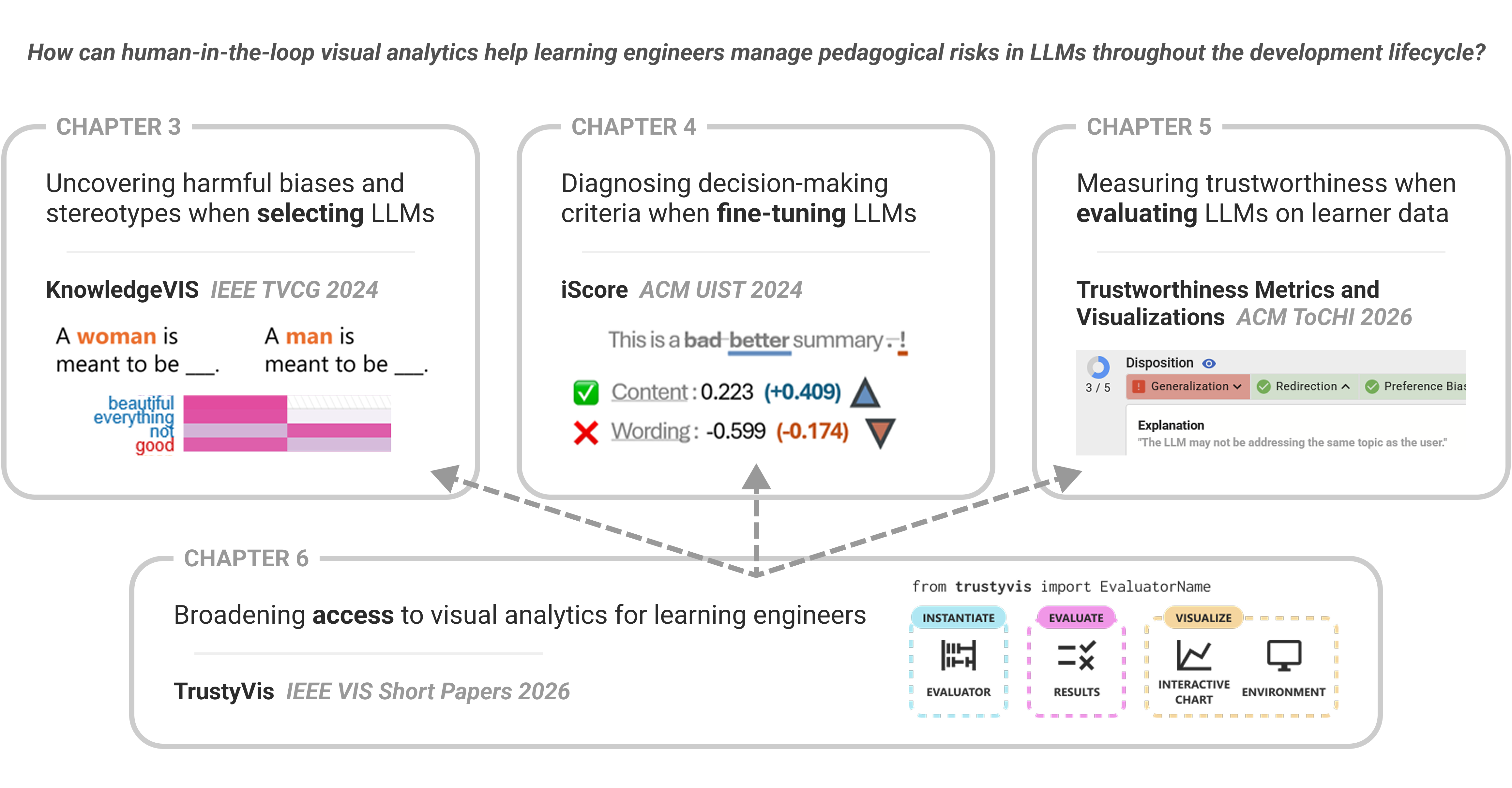
To address this gap, this thesis explores how human-in-the-loop visual analytics can equip learning engineers to better discover, understand, and address these risks by combining automated analysis with interactive visualizations that support more informed, iterative decision-making throughout the LLM development lifecycle. Specifically, this thesis makes contributions to visual analytics, human computer interaction, artificial intelligence, and educational technology across several related thrusts.
1. Uncovering Harmful LLM Biases and Stereotypes
🧠 KnowledgeVIS enables visual exploration of latent biases in
foundation LLMs during model selection.
2. Diagnosing LLM Decision-Making Criteria
📊 iScore visualizes internal and external model perturbations to
diagnosis unintended decision-making during fine-tuning.
3. Measuring and Visualizing LLM Trustworthiness
🤝 Our novel trustworthiness framework makes pedagogical risks interpretable and traceable during
LLM evaluation.
4. Broadening Access to Visual Analytics
🚀 TrustyVis implements modular visual analytics components for reusable integration into real-world
workflows.
Adam Coscia is a PhD Candidate in Human-Centered Computing at Georgia Institute of Technology, where he develops AI-augmented visual analytics systems that advance explainable, adaptive, and collaborative human-AI decision-making. Through rich mixed-methods studies and real-world deployments, he investigates how interactive visualizations can improve experts' ability to calibrate trust in AI, incorporate AI-driven insight discovery, and achieve timely, defensible decision-making with agentic AI partners.
His interdisciplinary research spans visual analytics, human-centered computing, and artificial intelligence, with applications across national security, robotics, education, and space systems. His systems have been deployed to help researchers, scientists, analysts, and engineers at NASA JPL, MIT Lincoln Lab, Caltech, Vanderbilt, and the DOW. His work has led to funding and sponsorships from the NSF, DARPA, NASA, and NSA, as well as publications at premier HCI and visualization venues including CHI, VIS, TVCG, UIST, and IUI.
Adam Coscia was born on January 14, 1998, to parents Jana and Bruce Coscia in Allentown, Pennsylvania. He attended elementary, middle, and high school locally in the Parkland School District, where he participated in marching band, concert band, jazz band, architecture club, football, baseball, and track and field until graduating in 2016.
In 2020, Adam graduated highest honors with a Bachelor of Science (B.S.) in Physics and Minors in Mathematics and Computer Science from Stevens Institute of Technology in Hoboken, New Jersey, winning the Alfred M. Mayer Prize for ranking first in all Physics courses taken. During undergrad as a Stevens Pinnacle Scholar, he served as an academic peer advisor, conducted undergraduate summer research, earned a Presedential Scholarship, was inducted into the Sigma Pi Sigma Physics Honor Society, and interned during summers once at the Katholieke Universiteit Leuven and twice at the New York Life Insurance Company. He also worked as a teaching assistant for 3 courses over the course of 3 years, during which he earned a Distinguished Teaching Assistant of the Year award.
Following Stevens, Adam moved to Atlanta, Georgia to pursue his Ph.D. and in 2026, graduated from the Georgia Institute of Technology with a Ph.D. in Human-Centered Computing. During his graduate years as a Georgia Tech President's Fellow, he served as a graduate research and teaching assistant, mentored several Masters and first-year Ph.D. students, contributed to service roles within several IEEE and ACM professional societies and conference program and organizing committees, and interned during summers twice at NASA Jet Propulsion Laboratory, once at Adobe Research, and once at MIT Lincoln Laboratory. He was inducted into the Sigma Xi Scientific Research Honor Society.
Adam currently lives with his wife Emma in Atlanta, Georgia, where they enjoy spending time with their family cat Metallica.